Dutch politician Geert Wilders has been acquitted of all charges of inciting hatred and discrimination after a lengthy trial. Commentator Mark Steyn terms the proceedings a "show trial." He certainly has a point; even the public prosecutor had already called for an acquittal.
If there was no case against him, why was Wilders on trial? In addition to domestic pressures, Wilders was the target of the Organization of the Islamic Conference (OIC), the international organization comprising over 50 Muslim countries. The OIC leaned hard on the Dutch government to punish Wilders; let's see what it does now.
Showing posts with label free speech. Show all posts
Showing posts with label free speech. Show all posts
Thursday, June 23, 2011


Tuesday, March 29, 2011
A plea from Pakistan
Libby sent me the link to this video, prepared by MEMRI, of an interview in which Pakistani actress Veena Malik responds to charges that she has shamed her family and her country by appearing in an Indian reality show. She challenges her accuser, Mufti Abdul Qavi, to focus on corruption, bribery, and other problems in Pakistan, including sexual abuses committed by the clergy, which are much more serious than the charges he has brought against her. Malik is a very brave and outspoken woman. Let's hope she survives - today's Pakistan is an increasingly dangerous place for someone like her.
Thursday, January 20, 2011
Free speech abroad
Today I have two reports from the front in the global battle for free speech about Islam. Note that in both cases the battle is not between Muslims and Westerners, but between Western authorities and their citizens.
The first, by Dutch lawyer and historian Thierry Baudet, chronicles the torturous path of the trial against Dutch politician Geert Wilders (which I've reported on before). In the first round, public prosecutor Paul Velleman refused to prosecute because he did not consider that various statements made by Wilders (comparing the Koran to Mein Kampf or calling Islam a violent religion) had broken the law. Then judges on the Court of Appeal essentially ruled that Wilders was guilty of hate speech and incitement to discrimination - in other words, pronounced him guilty, not even bothering to preserve any illusion of the presumption of innocence. The District Court in Amsterdam gave in to this pressure and brought Wilders to trial.
At the trial, Vellemans stuck to his original position. The judges disagreed. The trial continued until their bias became so evident that they were dismissed from the case. Wilders isn't out of the woods yet, though, as the case will be retried at some future point.
Nor is Wilders physically safe. As Baudet notes: "while Wilders’s remarks have aroused no social disorder of the sort that the Dutch laws were intended to prevent, he himself receives continual death threats and lives under permanent police protection."
The second case involves the National Archives of Canada. It cancelled the showing of Iranium, a new movie about Iran's quest for nuclear weapons, after receiving threats and two suspicious letters. (Watch the Iranium trailer here.) Fortunately, Canada's Heritage Minister James Moore then stepped in, arguing that cancelation was the equivalent of censorship and ordering the Archives to show the film. So far no date has been set.
The first, by Dutch lawyer and historian Thierry Baudet, chronicles the torturous path of the trial against Dutch politician Geert Wilders (which I've reported on before). In the first round, public prosecutor Paul Velleman refused to prosecute because he did not consider that various statements made by Wilders (comparing the Koran to Mein Kampf or calling Islam a violent religion) had broken the law. Then judges on the Court of Appeal essentially ruled that Wilders was guilty of hate speech and incitement to discrimination - in other words, pronounced him guilty, not even bothering to preserve any illusion of the presumption of innocence. The District Court in Amsterdam gave in to this pressure and brought Wilders to trial.
At the trial, Vellemans stuck to his original position. The judges disagreed. The trial continued until their bias became so evident that they were dismissed from the case. Wilders isn't out of the woods yet, though, as the case will be retried at some future point.
Nor is Wilders physically safe. As Baudet notes: "while Wilders’s remarks have aroused no social disorder of the sort that the Dutch laws were intended to prevent, he himself receives continual death threats and lives under permanent police protection."
The second case involves the National Archives of Canada. It cancelled the showing of Iranium, a new movie about Iran's quest for nuclear weapons, after receiving threats and two suspicious letters. (Watch the Iranium trailer here.) Fortunately, Canada's Heritage Minister James Moore then stepped in, arguing that cancelation was the equivalent of censorship and ordering the Archives to show the film. So far no date has been set.
How, one wonders would U.S. courts or public prosecutors handle a case similar to either of the ones above? Somehow I can't see Attorney General Holder, President Obama, or New York Mayor Bloomberg rising to the defense of free speech if that speech risked offending Muslims. Can you?
Wednesday, September 15, 2010
Bye bye First Amendment rights
Let's see: burning the U.S. flag is protected under the First Amendment, but not burning a Koran.
At least, that appears to be the reaction of Supreme Court Associate Justice Stephen Breyer. He speculated that, in this age of globalization, Koran burning could be compared to shouting 'fire' in a crowded theater.
So, if some radical imams in Pakistan or Egypt take offense at some cartoon which 99.99% of Americans believe to be inoffensive, where does Breyer draw the line?
Doesn't he understand that 'Muslim rage' isn't just a 'natural' reaction: that Muslim authorities can and should can be held responsible for either calming or inflaming the situation? Tawfiq Hamid last week in the Wall Street Journal (sorry, but I can't link to it) laid out ways in which this could be done.
And why is it that a Supreme Court Justice doesn't know this? Or, if he doesn't, why doesn't he inform himself before speaking out on the topic? (Thanks to CNS News.)
At least, that appears to be the reaction of Supreme Court Associate Justice Stephen Breyer. He speculated that, in this age of globalization, Koran burning could be compared to shouting 'fire' in a crowded theater.
So, if some radical imams in Pakistan or Egypt take offense at some cartoon which 99.99% of Americans believe to be inoffensive, where does Breyer draw the line?
Doesn't he understand that 'Muslim rage' isn't just a 'natural' reaction: that Muslim authorities can and should can be held responsible for either calming or inflaming the situation? Tawfiq Hamid last week in the Wall Street Journal (sorry, but I can't link to it) laid out ways in which this could be done.
And why is it that a Supreme Court Justice doesn't know this? Or, if he doesn't, why doesn't he inform himself before speaking out on the topic? (Thanks to CNS News.)
Friday, August 13, 2010
First Amendment legislation
I bet you haven't heard about HR2765 entitled "Securing the Protection of our Enduring and Established Constitutional Heritage Act." It's the new law protecting First Amendment rights of American authors and publishers from foreign libel lawsuits. I've written about it before; it's a vital piece of protection which passed both Houses of Congress unanimously (which in this day and age is saying something).
Perhaps the reason you didn't hear about the new law was that President Obama chose to sign it on August 10 with minimum publicity: no ceremony; a short press release; no press photo; only one Member of Congress present. And he's the most media-hungry President we've ever had.
Could it be that Obama lay low because he didn't want to offend Saudis who use foreign libel laws to silence critics like Dr. Rachel Ehrenfeld or J. Millard Burr who expose their financial ties to jihad? Just wondering...
Perhaps the reason you didn't hear about the new law was that President Obama chose to sign it on August 10 with minimum publicity: no ceremony; a short press release; no press photo; only one Member of Congress present. And he's the most media-hungry President we've ever had.
Could it be that Obama lay low because he didn't want to offend Saudis who use foreign libel laws to silence critics like Dr. Rachel Ehrenfeld or J. Millard Burr who expose their financial ties to jihad? Just wondering...
Thursday, June 3, 2010
To give offense - or not?
While Westerners are falling all over themselves to censor cartoons and anything else that any Muslim anywhere on the globe might deem offensive, two TV broadcasts to the Muslim world are fearlessly exposing controversial Islamic texts.
Raymond Ibrahim explains that Life TV, an evangelical Arabic satellite station, has two weekly programs, one hosted by Coptic priest Fr. Zakaria Botros, the other by ex-Muslim Rashid. Both programs ask uncomfortable questions about Islam and Mohammed; a number of Muslim countries, including Saudi Arabia, ban the station and it is frequently condemned on al Jazeera.
The broadcasts, which are viewed by millions of Arabic-speaking Muslims, caused an uproar at the start; Al Qaeda put a $60 million bounty on Zarakia's head. Life TV responded by providing even more anecdotes discrediting Mohammed. So how is all this being received? "Needless to say, Life TV's hosts ... are hated by Muslims around the world. But to the careful observer, the outrage appears to be subsiding, ostensibly replaced by apathy - that is, the default strategy when threats and displays of indignation fail."
Ibrahim concludes that "one need not agree with Life TV's tactics or evangelical mission to appreciate the lesson it imparts: Muslim outrage - as with all human outrage - is predicated on how well it is tolerated. Continuously appeased, it becomes engorged and insistent on more concessions; ignored, it deflates and, ashamed of itself, withers away."
Too bad no one pays any attention to these guys.
Raymond Ibrahim explains that Life TV, an evangelical Arabic satellite station, has two weekly programs, one hosted by Coptic priest Fr. Zakaria Botros, the other by ex-Muslim Rashid. Both programs ask uncomfortable questions about Islam and Mohammed; a number of Muslim countries, including Saudi Arabia, ban the station and it is frequently condemned on al Jazeera.
The broadcasts, which are viewed by millions of Arabic-speaking Muslims, caused an uproar at the start; Al Qaeda put a $60 million bounty on Zarakia's head. Life TV responded by providing even more anecdotes discrediting Mohammed. So how is all this being received? "Needless to say, Life TV's hosts ... are hated by Muslims around the world. But to the careful observer, the outrage appears to be subsiding, ostensibly replaced by apathy - that is, the default strategy when threats and displays of indignation fail."
Ibrahim concludes that "one need not agree with Life TV's tactics or evangelical mission to appreciate the lesson it imparts: Muslim outrage - as with all human outrage - is predicated on how well it is tolerated. Continuously appeased, it becomes engorged and insistent on more concessions; ignored, it deflates and, ashamed of itself, withers away."
Too bad no one pays any attention to these guys.
Sunday, May 23, 2010
And State wades in
The State Department has waded into the Motoon controversy, condemning the cartoons of Mohammed mentioned in my previous entry. Here's what the State spokesman said: "America does not condone expressions that lead to violence or hatred."
Just think of it: our federal government - or maybe he means all Americans - would never ever approve of a statement that might provoke someone else to violence. So think before you say or write anything again, because somewhere in the world someone might take exception to it.
Coincidentally, I would note that our new and improved definition of free speech just happens to be the same as that of the Organization of the Islamic Conference. Just when you think we can't sink any lower, we do.
Just think of it: our federal government - or maybe he means all Americans - would never ever approve of a statement that might provoke someone else to violence. So think before you say or write anything again, because somewhere in the world someone might take exception to it.
Coincidentally, I would note that our new and improved definition of free speech just happens to be the same as that of the Organization of the Islamic Conference. Just when you think we can't sink any lower, we do.
Friday, May 21, 2010
Motoon contest
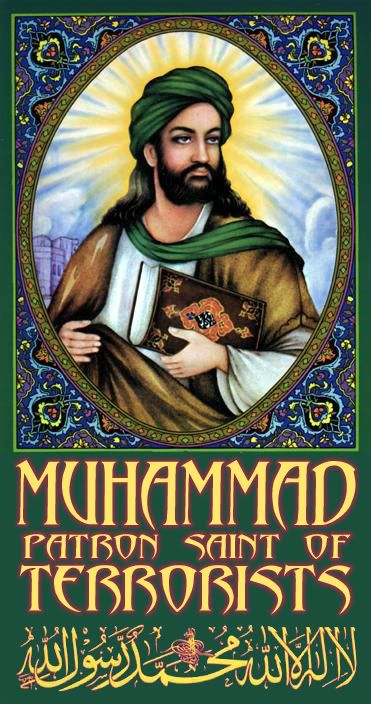
There was a 'Draw Mohammed Day' this week; if you go to Jihad Watch, you can find some samples, along with links to articles explaining why freedom of speech and the press is so important. To give you an idea of the flavor, here is one cartoon and here another. They range from a stick figure entitled 'Mohammed' to unambiguous political cartoons aimed at the 'Islam is a religion of peace' mantra.
Pakistan has already responded by blocking Facebook and YouTube for carrying the cartoons.
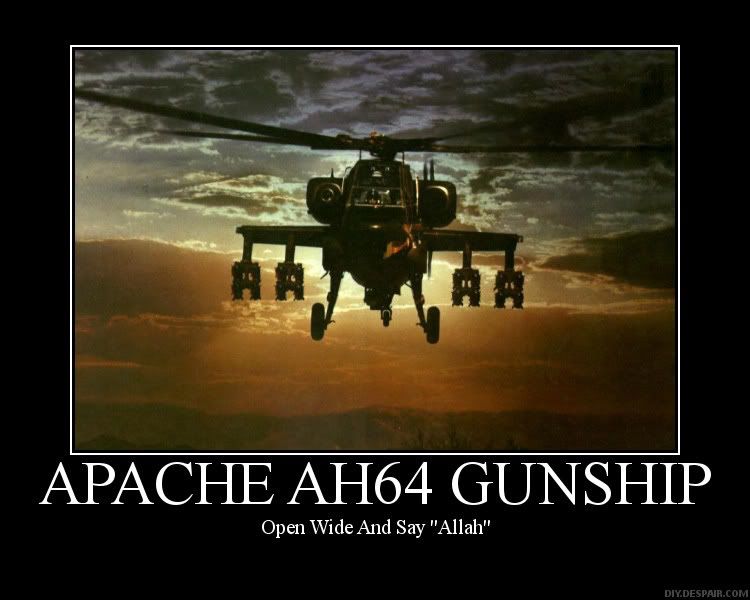
Here's my favorite image; although I admit it isn't exactly a picture of Mohammed, it is in the spirit of the event, and is inspired by David.

Pakistan has already responded by blocking Facebook and YouTube for carrying the cartoons.
Here's my favorite image; although I admit it isn't exactly a picture of Mohammed, it is in the spirit of the event, and is inspired by David.
Thursday, May 13, 2010
Vilks attacked
Ah yes, the university as the citadel of intellectual ferment and free speech. You saw one example in yesterday's post. Now, at Uppsala University in Sweden, cartoonist Lars Vilks is attacked by someone (identity unknown) while he was giving a talk. Others in the audience shouted "Allahu Akbar" which may give you some idea of their orientation.
Vilks is famous for his cartoon showing Mohammed's head on a dog's body (see above link), as well as being the target of various assassination schemes, including that of Jihad Jane.
Vilks is famous for his cartoon showing Mohammed's head on a dog's body (see above link), as well as being the target of various assassination schemes, including that of Jihad Jane.
Friday, March 12, 2010
I'm baaaaack!
Yes, I took a break from blogging, but am back with a link to an excellent piece by Christopher Hitchens on one of the latest attacks on free speech.
Having bullied the Danish newspaper Politiken into apologizing for publishing cartoons deemed offensive to Muslims, Saudi lawyer Ahmed Zaki Yamani is now trying to get other Scandinavian newspapers to fall in line. His threat: to sue them in the name of all the 94, 923 descendants of Mohammed and make their lives miserable. Of course, the threat of physical violence lurks in the background; a Somali nearly butchered one of the Danish cartoonists last New Year's Day.
The moral: apologizing doesn't work; it is viewed as a sign of weakness, and only results in further pressure to knuckle under.
Having bullied the Danish newspaper Politiken into apologizing for publishing cartoons deemed offensive to Muslims, Saudi lawyer Ahmed Zaki Yamani is now trying to get other Scandinavian newspapers to fall in line. His threat: to sue them in the name of all the 94, 923 descendants of Mohammed and make their lives miserable. Of course, the threat of physical violence lurks in the background; a Somali nearly butchered one of the Danish cartoonists last New Year's Day.
The moral: apologizing doesn't work; it is viewed as a sign of weakness, and only results in further pressure to knuckle under.
Monday, February 22, 2010
Reverse lawfare
I've referred in previous posts to the threat of 'lawfare': lawsuits launched against people who criticize Islam or Islamic organizations. The suits are designed to intimidate, bankrupt, or otherwise silence any voices of opposition.
Security expert David Harris, writing in The Ottawa Citizen, suggests a remedy for this problem: "Passengers and others victimized by terror threats should be encouraged to sue airlines and other entities that have failed in their duty to safeguard passengers’ well-being." It's certainly an idea!
Security expert David Harris, writing in The Ottawa Citizen, suggests a remedy for this problem: "Passengers and others victimized by terror threats should be encouraged to sue airlines and other entities that have failed in their duty to safeguard passengers’ well-being." It's certainly an idea!
Sunday, February 14, 2010
Update from Dallas
It seems that the Islamic Society of North America (ISNA) isn't taking the critical article about military chaplain and ISNA official Louay Safi referred to in my previous post lying down. Jihad Watch reports that ISNA is urging its members to contact the editor of the Dallas Morning News, or staff writer Brooks Egerton, to demand a retraction.
Note that ISNA doesn't claim that Egerton said anything inaccurate about Safi, just that what he said created a negative impression. That, by the way, is the classic definition in Islam for defamation - not that what you said is false, but that the person in question doesn't like it.
As for whether ISNA is linked to the Muslim Brotherhood (a question Joe raised after my last entry), here's a paper from The Investigative Project pointing out that ISNA itself has essentially confirmed such ties.
Jihad Watch urges those interested in freedom of the press to contact the Dallas Morning News to tell them not to apologize or retract the article. I've already done so; if you want to as well, here's the contact info:
Maud Beelman,
The DMN News Editor
Mbeelman@dallasnews.com
214-977-8456
Brooks Egerton,
staff writer
begerton@dallasnews.com
214-977-7622
Note that ISNA doesn't claim that Egerton said anything inaccurate about Safi, just that what he said created a negative impression. That, by the way, is the classic definition in Islam for defamation - not that what you said is false, but that the person in question doesn't like it.
As for whether ISNA is linked to the Muslim Brotherhood (a question Joe raised after my last entry), here's a paper from The Investigative Project pointing out that ISNA itself has essentially confirmed such ties.
Jihad Watch urges those interested in freedom of the press to contact the Dallas Morning News to tell them not to apologize or retract the article. I've already done so; if you want to as well, here's the contact info:
Maud Beelman,
The DMN News Editor
Mbeelman@dallasnews.com
214-977-8456
Brooks Egerton,
staff writer
begerton@dallasnews.com
214-977-7622
Sunday, January 24, 2010
Geert Wilders on trial
Here's the speech that Dutch parliamentarian Geert Wilders gave on January 20 at a pre-trial hearing before the Amsterdam District Court. Wilders is charged with having "intentionally offended a group of people, i.e. Muslims, based on their religion," as well as having incited to hatred and discrimination.
His argument: that people should have the freedom to criticize Islam as well as the freedom to call for the destruction of the West. As he points out: "I am being prosecuted for my political convictions. The freedom of speech is on the verge of collapsing. If a politician is not allowed to criticise an ideology anymore, this means that we are lost, and it will lead to the end of our freedom." His trial opens on February 3.
Wilders is particularly famous for his short film Fitna, released in March 2008, which juxtaposed certain passages from the Koran and vicious speeches by Muslim clerics with the violent and terrorist acts they inspired. His political party is now one of the two largest in the Netherlands, despite the fact that he lives under constant death threats. If the court finds against him, it will be condemning the 30% of the Dutch electorate that agrees with him.
His argument: that people should have the freedom to criticize Islam as well as the freedom to call for the destruction of the West. As he points out: "I am being prosecuted for my political convictions. The freedom of speech is on the verge of collapsing. If a politician is not allowed to criticise an ideology anymore, this means that we are lost, and it will lead to the end of our freedom." His trial opens on February 3.
Wilders is particularly famous for his short film Fitna, released in March 2008, which juxtaposed certain passages from the Koran and vicious speeches by Muslim clerics with the violent and terrorist acts they inspired. His political party is now one of the two largest in the Netherlands, despite the fact that he lives under constant death threats. If the court finds against him, it will be condemning the 30% of the Dutch electorate that agrees with him.
Tuesday, January 5, 2010
Women's rights in Norway
Author Bruce Bawer recounts here the saga of Hege Storhaug, an outspoken defender of the rights of immigrant Muslim women in her native Norway. She was beaten unconscious in her home on January 1, 2007, three years to the day before an assassin tried to kill Kurt Westergaard, the Danish cartoonist who drew the Mohammed-in-a-bomb-turban cartoon.
In Westergaard's case, the assailant was a Somali suspected of links to Al Qaeda. Storhaug believes her attackers may have been far leftists who make common cause with the Islamists. Certainly, the media hate frenzy against her has created an environment that inspires such acts.
You can argue about whether these incidents mark the coming of Eurabia (a Europe dominated by Islam) but you can't argue that, in Europe, thugs increasingly call the shots.
In Westergaard's case, the assailant was a Somali suspected of links to Al Qaeda. Storhaug believes her attackers may have been far leftists who make common cause with the Islamists. Certainly, the media hate frenzy against her has created an environment that inspires such acts.
You can argue about whether these incidents mark the coming of Eurabia (a Europe dominated by Islam) but you can't argue that, in Europe, thugs increasingly call the shots.
Sunday, December 20, 2009
Assault on free speech
I've reported before on efforts to pass the Free Speech Protection Act to protect American authors and publishers against foreign libel suits. In this article, Dr. Rachel Ehrenfeld describes the kind of libel suits now popping up.
In addition to the British one against her - which she lost in absentia - for alleging that a Saudi billionaire was financing Islamist terrorism, there a Brazilian one against a fellow who criticized Brazilian air traffic control (after he nearly died in a crash there), and a Canadian one against a New-Jersey-based writer who revealed that Al Qaeda members - designated as terrorists - who attended the McMaster's College of Engineering in Hamilton, Ontario, apparently left the school in 2004 with 180 pounds of nuclear waste.
Meanwhile, this column from the Wall Street Journal lists other cases: A Boston company that sued a British cardiologist in London for criticism he made about the clinical trials of a device used in heart surgery; or an Icelandic businessman who used London courts to sue an Icelandic academic for comments on the University of Iceland's website.
The British are talking about changing their libel law, which is all to the good. However, as these examples show, the problem has already spread to other countries. It would help if Congress just did the obvious - if it passed the Free Speech Protection Act (which to my knowledge has NO budgetary implications). It's not just the individual writers and publishers who would benefit; free speech is the vital element that keeps our system honest.
In addition to the British one against her - which she lost in absentia - for alleging that a Saudi billionaire was financing Islamist terrorism, there a Brazilian one against a fellow who criticized Brazilian air traffic control (after he nearly died in a crash there), and a Canadian one against a New-Jersey-based writer who revealed that Al Qaeda members - designated as terrorists - who attended the McMaster's College of Engineering in Hamilton, Ontario, apparently left the school in 2004 with 180 pounds of nuclear waste.
Meanwhile, this column from the Wall Street Journal lists other cases: A Boston company that sued a British cardiologist in London for criticism he made about the clinical trials of a device used in heart surgery; or an Icelandic businessman who used London courts to sue an Icelandic academic for comments on the University of Iceland's website.
The British are talking about changing their libel law, which is all to the good. However, as these examples show, the problem has already spread to other countries. It would help if Congress just did the obvious - if it passed the Free Speech Protection Act (which to my knowledge has NO budgetary implications). It's not just the individual writers and publishers who would benefit; free speech is the vital element that keeps our system honest.
Friday, October 30, 2009
'Free' press
The countries that belong to the Organization for Security and Cooperation in Europe (OSCE) are electing a representative on freedom of the media. The two frontrunners are Russians, according to this article from Radio Free Europe. One, Oleg Panfilov, is likely to be voted down by the governments whose policies he has criticized in the past; the other, Mikhail Fedotov, has helped to defend Russian policies that have destroyed the free press.
So how will the OSCE's West European members vote? For Fedotov, "as a small compromise to make in order to secure a good gas deal or get a pipeline built"?
And, more generally, how did the OSCE get so far down the wrong road? During the Cold War, it actually stood for something; now it's hard to tell. Since the United States is also a member, this isn't just an idle question.
So how will the OSCE's West European members vote? For Fedotov, "as a small compromise to make in order to secure a good gas deal or get a pipeline built"?
And, more generally, how did the OSCE get so far down the wrong road? During the Cold War, it actually stood for something; now it's hard to tell. Since the United States is also a member, this isn't just an idle question.
Wednesday, October 14, 2009
Wilders vindicated
The UK Asylum and Immigration Tribunal has overturned the Home Office decision of last February to ban Dutch politician Geert Wilders from the country. The Home Office had ruled that Wilders represented "a genuine, present and sufficiently serious threat affecting one of the fundamental interests of society."
The Islamists who threatened violence, should he be allowed to enter the country, were not included in that category. As commentator Jacob Laksin notes: "the simple fact that British authorities felt forced to ban a critic of radical Islam rather than risk a confrontation with its adherents served as powerful proof of Wilders’s longtime charge that Europe no longer had the will to defend its laws and culture against Islamic extremists."
Wilders' legal team included a British Muslim attorney, Arfan Khan - there's a guy with guts!
(Thanks to Front Page Magazine.)
The Islamists who threatened violence, should he be allowed to enter the country, were not included in that category. As commentator Jacob Laksin notes: "the simple fact that British authorities felt forced to ban a critic of radical Islam rather than risk a confrontation with its adherents served as powerful proof of Wilders’s longtime charge that Europe no longer had the will to defend its laws and culture against Islamic extremists."
Wilders' legal team included a British Muslim attorney, Arfan Khan - there's a guy with guts!
(Thanks to Front Page Magazine.)
Tuesday, October 6, 2009
Another book bites the dust
This time, it's a German mass-market crime novel about honor killings, in which one of the characters makes a crude reference to the Koran. For fear that this reference might offend Muslims and lead to violence, the Droste publishing house in Dusseldorf has cancelled its contract. The book had been scheduled to appear in September. (Thanks to Jihad Watch.)
Monday, October 5, 2009
What's in a phrase?
The Organization of the Islamic Conference (OIC) has for years been trying to gain international acceptance for the concept of 'religious defamation': that freedom of speech cannot be used to scrutinize or criticize a religion (Islam).
Having joined the UN Human Rights Council, the United States sponsored a resolution on freedom of speech that aimed to find a compromise between the Islamic nations and the West. That resolution just passed unanimously. Egypt, a country notorious for suppressing free speech, was the co-sponsor.
According to the CNS News report: "The resolution drops the phrase 'religious defamation' but refers to “negative racial and religious stereotyping,” and condemns any advocacy of “religious hatred that constitutes incitement to discrimination, hostility or violence.” It urges governments to “address and combat such incidents,” in line with their obligations under international law.
Anne Bayefsky, in her analysis, criticizes the Obama administration for 'backing calls for limits on freedom of expression.' She says that 'other Western governments ... watched the weeks of negotiation with dismay as it became clear that American negotiators wanted consensus at all costs.'
Indeed, the 'compromise' language looks like it creates the proverbial hole big enough to drive a truck through. Such an outcome is definitely not in the U.S. interest.
Having joined the UN Human Rights Council, the United States sponsored a resolution on freedom of speech that aimed to find a compromise between the Islamic nations and the West. That resolution just passed unanimously. Egypt, a country notorious for suppressing free speech, was the co-sponsor.
According to the CNS News report: "The resolution drops the phrase 'religious defamation' but refers to “negative racial and religious stereotyping,” and condemns any advocacy of “religious hatred that constitutes incitement to discrimination, hostility or violence.” It urges governments to “address and combat such incidents,” in line with their obligations under international law.
Anne Bayefsky, in her analysis, criticizes the Obama administration for 'backing calls for limits on freedom of expression.' She says that 'other Western governments ... watched the weeks of negotiation with dismay as it became clear that American negotiators wanted consensus at all costs.'
Indeed, the 'compromise' language looks like it creates the proverbial hole big enough to drive a truck through. Such an outcome is definitely not in the U.S. interest.
Tuesday, September 8, 2009
Good news from Canada
The Canadian Human Rights Tribunal just ruled that a clause granting the Canadian Human Rights Commission the legal grounds to pursue such people as Mark Steyn for indulging in 'hate speech' is unconstitutional. This is great news - hate speech restrictions may be well-intentioned, but they end up restricting free speech.
As for Mark Steyn, he remarks that similar challenges to free speech lie in wait in the United States, in the form of Obama administration proposals to reimpose Fairness Doctrine restrictions and otherwise muzzle its political opponents.
As for Mark Steyn, he remarks that similar challenges to free speech lie in wait in the United States, in the form of Obama administration proposals to reimpose Fairness Doctrine restrictions and otherwise muzzle its political opponents.
Subscribe to:
Comments (Atom)